The ocean question
Most people think appetite is a super simple thing: Are you hungry? Yes or no?
But that's like asking, is the ocean water?
Yeah, but it's also a whole bunch of other things. Salt. Currents. Pressure. Tides. Temperature. Depth you can't see from the surface. A yes-or-no question can't capture that—and neither can it capture your appetite.
I've spent years listening to women describe their relationships with food. Accomplished, intelligent women who navigate complexity in every other domain of their lives. Yet when it comes to hunger, they feel lost.
Not because something is wrong with them. Because they were never given the tools to understand what their body is actually communicating.
That's where Appetite Literacy comes in—the foundational skill of The Shift.
What diet culture stole
Decades of dieting teach one thing: ignore your body.
Don't eat until 12 PM. Stop eating by 7 PM. Count these points. Avoid those foods. Follow this plan created by someone who has never met you.
Every rule is designed to override what your body is telling you. And every time you override those signals, you lose a little more connection to them.
Diet culture doesn't just fail to teach you how to read your appetite. It actively destroys your ability to do so.
Then when the diet fails—and it always does—you blame yourself. But willpower was never the problem. You cannot hate yourself into health. You were trying to navigate a complex system with a broken compass.
Hunger isn't simple
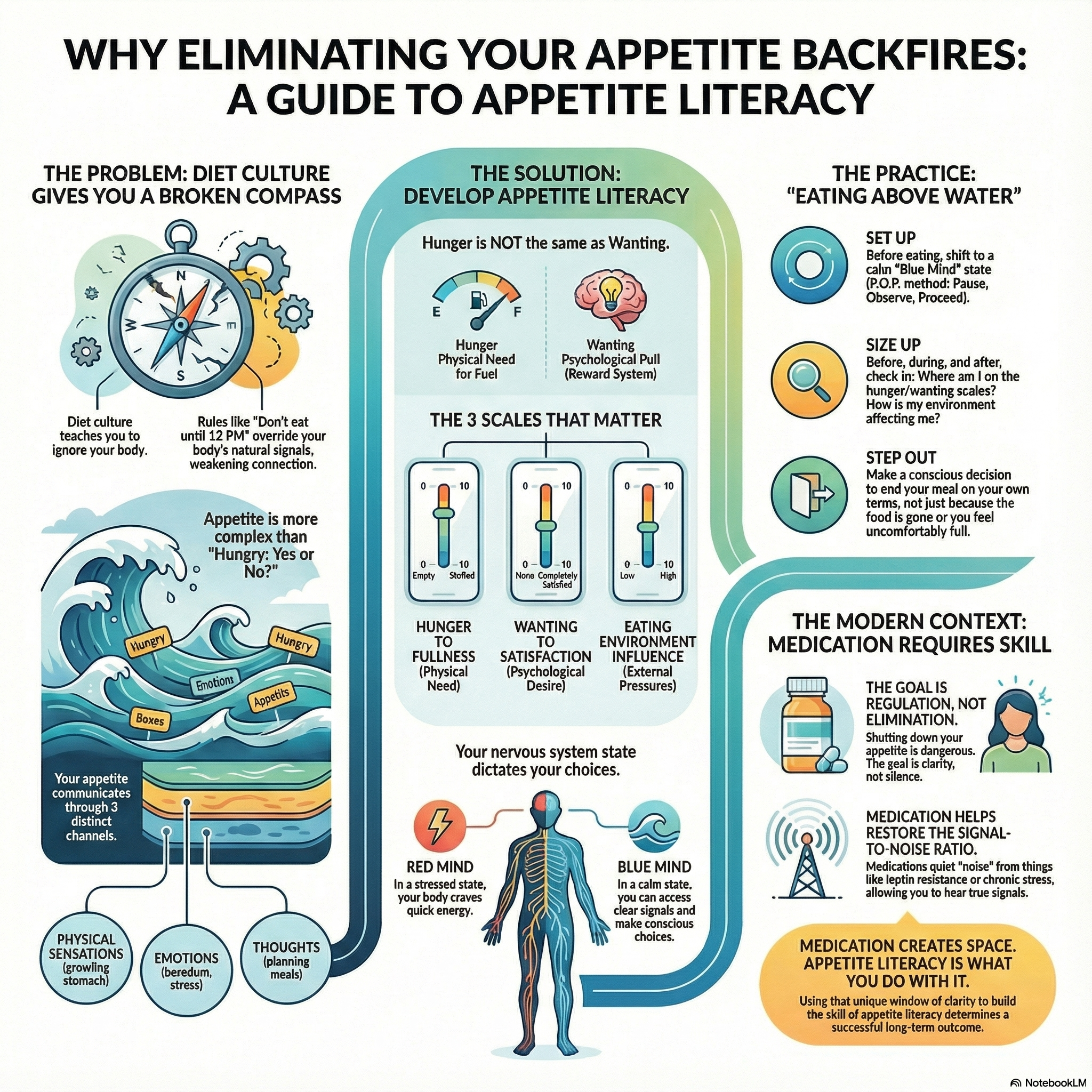
Your appetite communicates through three distinct channels simultaneously:
Sensations are the physical cues—stomach emptiness, growling, shakiness, low energy. Real, but only one piece.
Emotions show up too—irritability, boredom, anxiety, excitement. That 3 PM pantry pull isn't always about fuel.
Thoughts are the cognitive dimension—"I need to eat soon," obsessive thinking about food, mental planning around meals.
Reading appetite accurately means noticing all three channels. Most people have only ever paid attention to one—if that.
Hunger versus wanting
Hunger and wanting are not the same thing. This distinction changes everything.
Hunger is the physical need for fuel, metabolic, mediated by hormones like ghrelin. Hunger doesn't care what you eat; any food will quiet it.
Wanting is the psychological pull toward specific foods, driven by dopamine and your reward system. You can be genuinely, physically full and still experience intense wanting for dessert.
That's not a weakness. That's neuroscience.
When you're eating past fullness into wanting, you're not responding to a fuel need—you're responding to something else: stress, reward-seeking, emotional regulation, habit. And that requires a different response than eating.
This is why willpower-based approaches fail. They treat all eating urges as the same problem. But hunger and wanting are different signals requiring different skills.
The scales that matter
In The Shift, we use three dimensions to map appetite, each rated on a 0-10 scale. That's information, not a judgment—just data you can work with.
Hunger to Fullness measures physical need for fuel. Zero is starving; ten is painfully stuffed.
Wanting to Satisfaction measures psychological desire for food—independent of physical hunger. You can be at 7 on fullness and 2 on wanting simultaneously. That's not contradictory. That's how the system works.
Eating Environment Influence assesses external pressures that make signals hard to read—stress, distraction, social pressure, and internalized rules.
When you track these dimensions, patterns emerge. You discover that certain environments tank your ability to read signals. You notice wanting spikes at specific times regardless of hunger. This is appetite literacy in action: reading, tracking, interpreting.
Why your nervous system matters
You can't read your appetite when your nervous system is in emergency mode.
When stress activates your sympathetic nervous system, several things happen at once. Metabolism drops. Digestion slows. Your prefrontal cortex goes offline. You become reactive rather than responsive.
In this state—what I call Red Mind—you're driven toward rapidly available fuel: sweet, easy to digest, providing immediate pleasure. Your body is prioritizing survival, not long-term goals. This isn't moral failure. This is physiology.
The opposite state—Blue Mind—happens when your parasympathetic nervous system is dominant. Metabolism increases. Digestion works optimally. You can clearly sense your appetite signals. Choice becomes possible.
Sustainable eating requires access to Blue Mind. Nervous system regulation must precede appetite regulation.
Eating above water
The Shift System is a three-step practice for bringing conscious intention to eating. We call it Eating Above Water because it moves you from reactive, automatic eating into responsive, conscious choice.
Set Up uses a single breath cycle—POP (Pause, Observe, Proceed)—to shift your nervous system before eating. The brain prioritizes oxygen and glucose; providing both creates a physiological safety that allows accurate appetite reading.
Size Up is where you apply appetite literacy. Check your coordinates: Where am I on the hunger scale? On wanting? How is my environment affecting my signals? This happens before the first bite, during eating, and just before stopping. No judgment. Just reading.
Step Out is the conscious decision to end on your own terms—not when food runs out or discomfort forces you to stop. A chosen ritual marks intentional completion.
This three-step practice transforms eating from something that happens to you into something you navigate deliberately.
Why this matters for weight
People who successfully maintain weight loss develop the ability to self-regulate their eating based on internal signals rather than external rules. That's appetite literacy. That's the skill.
This is fundamentally different from following a diet. Diets give you rules to follow. Appetite literacy gives you skills for life—skills that adapt as your body changes, your circumstances shift, and your life evolves.
The MAP Framework—Metabolism, Appetite, Perspective—organizes this into a coherent structure. We're working with your physiology, not fighting it.
Regulation, not elimination
The goal of weight loss treatment is not to eliminate your appetite. It is always a bad idea to shut down communication between your body and your brain.
Eliminating appetite is dangerous. It's also not fun. And it will backfire.
Your appetite exists for a reason. Shut it down entirely, and you lose critical information. You under-eat. You lose muscle. You feel flat, disconnected from pleasure. Eventually, something breaks.
I see this in my practice: patients on appetite-suppressing medications at doses too high for too long, who've lost touch with hunger entirely. They don't know when to eat. They feel weak, irritable, and cognitively foggy. And when they do eat, they often overeat—because they've lost the ability to sense fullness too.
The goal isn't silence. The goal is clarity.
A regulated appetite still produces hunger. It still allows wanting. It still enables you to enjoy food. What it doesn't do is scream so loudly you can't hear yourself think. What it doesn't do is override your intentions every time stress hits.
Regulation means the signal is readable. Elimination means there's no signal at all.
The paradox patients face
I hear this in consultations all the time: "I already feel like I don't have much of an appetite. Why would I take a medication that suppresses it further?"
Fair question. But what if something else was true here?
You can feel like you have no appetite and still struggle with eating. You can rarely feel hungry and still eat more than you intended. You can have zero interest in food mentally and still reach for it reactively throughout the day.
"Not feeling hungry" and "having a regulated appetite" are completely different things.
When appetite signals are dysregulated, you often lose access to hunger sensations entirely. But that doesn't mean the drive to eat disappears—it means you've lost your reliable navigation system.
So you don't feel hungry. You skip meals or under-eat during the day. Then something triggers eating—stress, the clock, or seeing food. Without hunger signals to guide you, you start. Without fullness signals, you don't know when to stop. You eat past comfortable fullness, into wanting, until external factors force you to stop.
Then you wake up the next morning still not hungry—because you ate so much the night before—and the cycle continues.
This isn't about willpower. This is about wiring.
When medication makes sense
Appetite-modifying medication often helps most when someone feels like they "don't have an appetite." That sounds counterintuitive until you understand the physiology.
Leptin resistance: Leptin signals fullness to your brain. When you carry more weight, you produce more leptin, but your brain can become resistant, like living next to train tracks and eventually not hearing the trains. Medications can help restore that sensitivity.
Hedonic override: When reward-seeking pathways are so activated that wanting drowns out metabolic signals, you don't feel hunger because wanting is running the show. Medications that quiet the hedonic noise allow homeostatic signals to become audible again.
Chronic stress physiology: When you've been in Red Mind for months, cortisol scrambles your metabolic signalling. You might feel no hunger while simultaneously being driven toward quick-energy foods. The medication isn't suppressing an already absent hunger; it's recalibrating a system that's sending distorted signals.
The goal isn't to further suppress appetite. It's to restore the signal-to-noise ratio—to quiet the interference so you can actually hear what your body is communicating.
What happens without understanding
Without appetite literacy, medication can backfire.
You might interpret medication as "I should never feel like eating." You ignore hunger entirely. You under-eat, losing muscle mass rather than fat.
Or you notice that wanting still shows up—because medication quiets the homeostatic system more than the hedonic one—and conclude the medication isn't working. Defeated, you stop treatment.
Or you lose weight without developing any skills. When medication adjustments happen, you're starting from zero.
The medication creates space. What you fill that space with determines your outcome.
The skill you need
Appetite literacy isn't optional. It's the skill that makes everything else work.
Weight loss medications can quiet the noise dramatically—the first time in years that food thoughts don't dominate your mental landscape. That clarity is the gift. But you still need to know how to read the signal.
Hunger is signal, not a command. You should still feel hungry—ideally three times a day. Appetite literacy means you can distinguish between "this medication is working" and "I've lost touch with my body." It means you can adjust your eating based on actual signals, not medication schedules.
When your biology changes—and it will—you'll have the skills to navigate it. Not through force. Through understanding.
Starting the practice
Start by noticing the three channels—sensations, emotions, thoughts—next time you feel the urge to eat. Ask yourself: Is this hunger or wanting?
No judgment. Just curiosity.
If you want structured guidance, The Shift Clinic provides medical care, education, coaching, community, and strategy sessions—all integrated around teaching appetite literacy.
Ready for comprehensive support? Explore The Shift Clinic and discover what it means to finally understand your own appetite.
Because your appetite isn't broken. Your body is not a problem to solve. It's been speaking a language no one taught you to understand.
Until now.