Should You Weigh Yourself? A Decision That Depends on You

the divided camps
Almost everyone has an opinion about whether you should weigh yourself. The wellness world has split into factions. There is the daily weigh-ins for accountability camp on one side, and the ditch-the-scale-forever camp on the other. Both sides are convinced they're right, yet they're missing the point.
The question isn't whether weighing yourself is good or bad. The question is whether you get useful information from the scale, or whether you get what I call a data hangover. Researchers describe self-weighing as a "double-edged sword" because the same act that helps some people maintain their weight sends others into emotional spirals that sabotage their progress. The difference isn't discipline or weakness but how your particular nervous system responds to a number.
two different scales
Before we go further, I want to distinguish between two contexts for weighing that look similar on the surface but aren't the same at all.
Clinical weighing happens in a medical setting with professional interpretation. Your physician tracks trends over time, correlates weight with other markers like body composition, metabolic labs, and medication response, and uses that data to inform your care. This is weight as medical information; it’s contextualized, interpreted, and integrated into a larger picture.
When I weigh patients in my practice, that number becomes one data point among dozens, and honestly, it's often not the most important one. A 2025 study from the University of Florida found that BMI showed no statistically significant association with mortality over fifteen years, while body composition measures (ie: how much of your weight is fat versus muscle, and where that fat lives) predicted health outcomes far more accurately. The scale in my office sits alongside bioelectrical impedance analysis, blood pressure trends, and metabolic markers. It doesn't get to tell a story all by itself.
Self-weighing at home is different. You're the interpreter. You decide what the number means. And most people haven't been trained to interpret weight data accurately which means the scale becomes less a source of information and more a trigger for the Inner Critic.
This article is about home weighing: whether to do it, how to decide, and what to do if you choose to step on that scale.
three directions
In my practice, I never tell patients what to do about self-weighing. It doesn't work, and honestly, you know yourself better than I do. But I help people make decisions, so let me share the framework I use.
You genuinely don't want to. If you have no instinct to weigh yourself, no desire to track this particular data point, no sense that it would serve you, then don't. There's no rule saying you must weigh yourself to make progress. Some of my most successful patients never step on a home scale; they track other things like how clothes fit, how they feel, how their energy shifts across the day. Weight isn't the only metric that matters, and for some people, it's not even the most useful one.
You genuinely want to. Maybe weighing yourself is already part of your routine and you find the information useful. The research actually supports this for the right person. A large cohort study of over 10,000 smart scale users found that people who weighed themselves consistently (about three times per week) maintained modest weight loss over nearly three years, while those who weighed infrequently tended to regain. So if monitoring works for you without causing emotional distress, that's fine with some guardrails. Keep it to weekly at most, record the number somewhere so it doesn't become a story that shifts in your mind, and move on with your day. If you're working with a clinician, share that data so it can be contextualized alongside everything else.
You're not sure. This is where most people live. You sort of want to weigh yourself. You can also see how it might not be a good idea. Maybe you've spiraled in the past. Maybe you're not sure whether the information helps or hurts. If this is you, there’s one question worth sitting with: does that number inform your next decision, or does it follow you through your day?
the data hangover
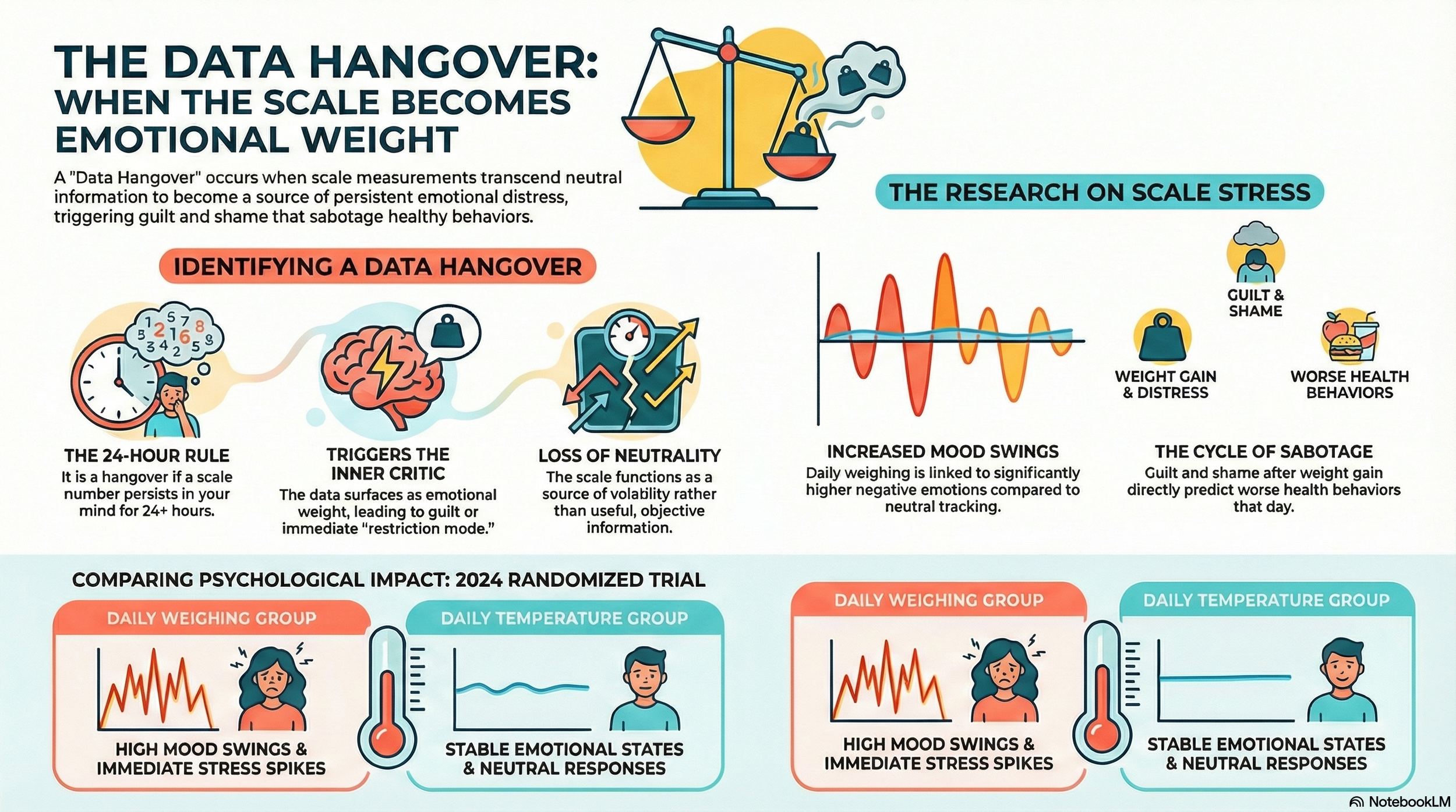
A data hangover happens when a number on the scale takes up residence in your mind and refuses to leave.
You step on the scale. The number is higher than expected. And then what happens? Do you note it and move on, or does that number follow you through your morning, your afternoon, into the evening? Does it show up uninvited while you're trying to focus on something else entirely? Does it trigger a cascade of thoughts about failure, about trying harder, about what you did wrong?
If that number is on your mind for 24 hours, you have a data hangover. If it surfaces multiple times over the following week, not as neutral information, but as emotional weight, you have a data hangover. If the scale triggers your Inner Critic, floods you with guilt, or sends you into restriction mode, you have a data hangover.
The term might sound light. The phenomenon isn't. A 2024 randomized trial compared young women who weighed themselves daily to a control group who took their temperature daily instead. The weighing group showed significantly higher mood swings, particularly for negative emotions as their stress about weight jumped immediately after stepping on the scale, while the temperature group stayed stable. The researchers measured something I see constantly in practice: the scale functioning as a source of emotional volatility rather than useful information. And here's what matters most: another study found that guilt and shame after a weight gain directly predicted worse health behaviors for the rest of that day. The very emotions the scale triggered made it harder to do the things that would actually help.
when the critic speaks
Your Inner Critic lives in that murky underwater space where everything feels catastrophic and true even when it isn't. The Critic says things like: "You shouldn't have eaten that." "You're so weak." "Everyone else can do this except you."
The scale is one of the Critic's favorite amplifiers. A higher number becomes proof of failure. A lower number becomes a fragile victory that must be defended at all costs. Either way, the Critic wins because the Critic isn't interested in information. The Critic is interested in judgment.
Your Inner Coach lives above water. The Coach holds you with unconditional positive regard and says: "That's data. Let's see what it tells us. What do you need right now?"
This isn't just a nice metaphor, either. Research confirms that self-compassion changes how women respond to weighing. Women with higher self-compassion are less likely to engage in restrictive eating or obsessive body surveillance when they weigh themselves frequently. Women without that buffer are more likely to spiral. The Coach isn't optional; she's protective. If stepping on the scale reliably summons your Critic rather than your Coach, that's signal. That’s information about you, about what serves your progress and what sabotages it. And that information is more valuable than any number the scale could show.
the biology of fluctuation
Let's say you've decided you want to weigh yourself and you're considering daily check-ins. I'd encourage you to think carefully, because the problem with daily weighing isn't the act itself but the interpretation. Daily weight fluctuates for reasons that have nothing to do with whether you gained fat, and most people attribute those fluctuations to things that didn't actually cause them.
You eat a normal meal. Your liver manufactures glycogen, a large, starchy storage molecule that pulls water from your digestive system into your tissues. The next morning, you're a bit heavier because you're temporarily holding water and stored fuel that your body will release and use over the following days. This is biology, not failure. But most people don't know this. They step on the scale, see a higher number, and immediately link it to whatever they ate the night before. They feel guilt. They restrict. They create exactly the kind of scarcity mindset that makes sustainable weight management harder, not easier.
You cannot hate yourself into health, and yet that's exactly what the Critic tries to do with daily scale data. Daily data is noisy. If you can't unlink a specific meal from the scale number the next morning, if you can't hold the data lightly and resist the urge to over-interpret, then you've got too much information coming in. You're looking for signal in what is mostly noise. And the Critic is happy to fill in the gaps with stories that aren't true.
why this hits women harder
I want to name something directly: women are disproportionately affected by the psychological weight of weighing. Research shows that 69 to 84 percent of women desire a lower body weight, which means most of us step on the scale already primed to feel disappointed. We’re told it’s weakness or vanity when it's actually the result of decades of cultural messaging that equates thinness with worth. Diet culture taught us to override our bodies' signals, and every time we overrode those signals, we lost a little more connection to them. Then when the diet failed (and it always does) we blamed ourselves.
In my practice, I see this pattern constantly: accomplished, intelligent women who navigate complexity in every other domain of their lives feeling lost when it comes to their own bodies. Not because something is wrong with them, but because they were never given the tools to understand what their body is actually communicating. The scale amplifies what's already there. If body dissatisfaction is running in the background, which it is for most women, the scale turns up the volume.
making the decision
So how do you decide? Here's what I work through with patients.
Start with your instinct. If you genuinely don't want to weigh yourself, honour that. If you genuinely do, proceed with awareness. Assess your data hangover risk by asking yourself honestly: Have you spiraled from scale numbers before? Does a higher weight trigger your Critic? Does it change how you eat for the next several days? If yes, proceed with caution or not at all.
Consider the actual value. What strategic information does the scale give you? Does it inform decisions you're making about your health? Or is it just a number you check reflexively without any real plan for what to do with it?
Set boundaries that serve you. If you decide to weigh yourself, make it weekly at most. Record the number and don't let it become a story that shifts and distorts. Move on. If you're working with a clinician, share your data so it can be interpreted in context.
Check your values. Are you chasing a number because you believe that number will finally make you enough? That's Pirate Mind: the fixation on treasure rather than the journey. The Shift aims for something different: Life Weight, a range where you can live without spending all your time thinking about food and weight.
what clinical monitoring offers
This is where working with a physician changes the equation.
In clinical care, weight is one data point among many. We look at body composition: not just total weight, but where mass is distributed, how much is muscle versus fat, how those ratios shift over time. We look at metabolic markers, medication response, energy patterns, sleep, stress, and the full context of your life. We track trends rather than single points. One higher number doesn't mean anything in isolation; what matters is the pattern over weeks and months, interpreted alongside everything else we know about you.
This matters more than most people realize. Body fat percentage measured through bioelectrical impedance analysis predicts health outcomes significantly better than weight alone; the same technology can identify visceral fat (the metabolically dangerous kind around your organs) with remarkable accuracy. Meanwhile, the scale in your bathroom can't distinguish between the weight you're carrying as muscle and the weight you're carrying as fat. It can't tell you whether yesterday's dinner is still making its way through your digestive system. It definitely can't tell you your value as a person.
This is the difference between raw data and clinical intelligence. At home, you have the number. In a clinical relationship, you have context, interpretation, and a framework for understanding what the data actually means.
the number isn't you
Your weight is information about your body. It's not information about your worth, your discipline, your character, or your future.
The scale measures mass under gravity. That's it. It doesn't measure hydration status, glycogen stores, or where you are in your menstrual cycle. It doesn't measure muscle versus fat. It doesn't measure the meal you ate last night still making its way through your digestive system. When you stop reducing yourself to a number, you make room for real progress, not progress measured only by the scale but by how you feel, how you move through your day, what your relationship with food looks like, and whether your body is carrying you toward the life you actually want.
Your body is a vessel not defined by what it weighs, but by its seaworthiness, its capacity to carry you toward what matters. The scale is just one instrument on the ship. It's not the destination.
your own answer
If you're still not sure whether to weigh yourself, that's okay. Start by noticing what happens when you do. Pay attention to your thoughts, your emotions, your behavior in the hours and days that follow. That's the information that actually matters.
Not sure where to begin with understanding your body's signals? Take our quiz to discover what kind of support might help.
Want to explore how The Shift approaches weight care: integrated, evidence-based, and focused on what actually matters? Start here.
Ready to learn the skills that make self-monitoring serve you rather than sabotage you? The Shift Weekender teaches appetite literacy, the Critic-to-Coach shift, and the framework for making decisions that align with your values.
Because ultimately, this isn't about whether you weigh yourself. It's about whether you can hold any data—including the number on the scale—with the kind of clarity and self-compassion that actually moves you forward.