Body Composition Is Not a Luxury Gimmick Test: How The Shift Clinic Uses the InBody970 for Patient Success

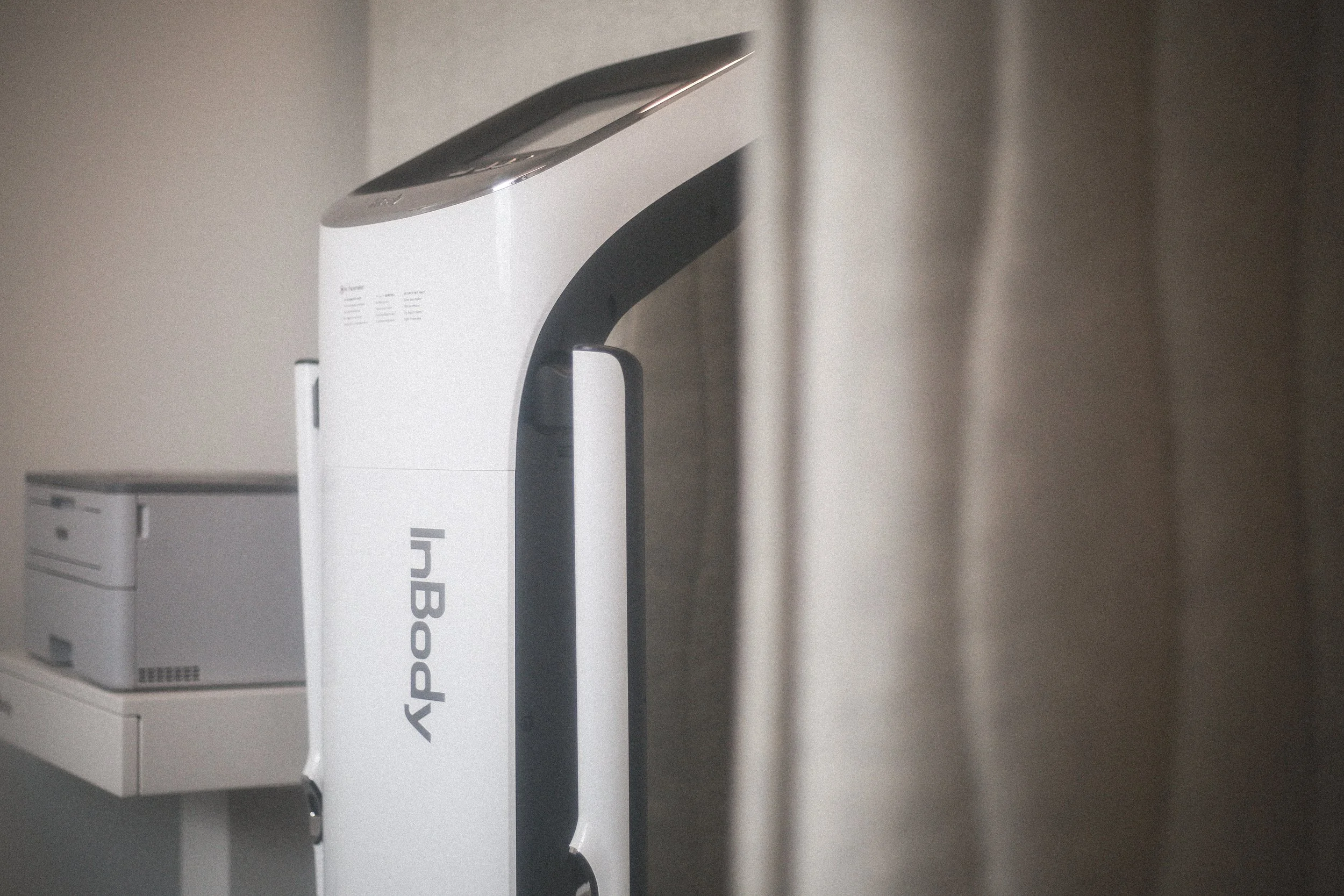
InBody Canada published a spotlight on The Shift Clinic this month, and the piece captures something I've been trying to articulate for a while: body composition testing is not an add-on service. It is a clinical tool. It is part of my physical exam.
You can read the full feature here, but I want to go deeper on something the article touches on that deserves more room.
When we talk about precision in metabolic medicine, most people assume we mean expensive and technical things. But the single most impactful technology change in my practice was adding a seventy-second test that my patients now experience as naturally as having their blood pressure taken.
What a scale actually tells you
Weight is a composite number. It is the sum of your bones, your organs, your water, your muscle, and your fat, compressed into a single figure. It tells you what gravity does to your body. It does not tell you what is happening inside it.
A patient can lose four pounds on a scale and feel like she is making progress. She may be losing muscle. A patient can gain two pounds on a scale and feel like she has failed. She may be building lean tissue while losing fat. Without body composition data, neither of us knows which story is true.
This is not a theoretical problem. It is the daily clinical reality of obesity medicine.
The variables that matter
In my practice, I track a specific set of InBody variables at every in-person visit. These are not chosen for novelty.
Each one answers a clinical question that weight alone cannot:
Visceral fat area is the most metabolically dangerous fat depot in the body. It surrounds internal organs and drives insulin resistance, cardiovascular risk, and systemic inflammation. Two patients at the same BMI can have vastly different visceral fat levels, which means vastly different risk profiles. Tracking visceral fat area over time tells me whether a patient's metabolic risk is actually improving, regardless of what the scale says.
Skeletal muscle mass and the skeletal muscle index tell me whether we are preserving lean tissue during fat loss. This is critical for women in midlife, and it is non-negotiable when patients are on medications that cause significant weight change. Muscle is the organ of longevity. Losing it is not an acceptable trade-off.
The ECW/TBW ratio — the balance between extracellular and total body water — is a marker I watch for early signs of fluid retention, inflammation, or metabolic stress. When this ratio climbs, it tells me something is shifting before symptoms appear.
Basal metabolic rate, derived from lean mass, gives me objective data for nutrition planning rather than relying on population-level estimates that may not reflect a specific patient's physiology.
Phase angle, measured at the segmental level, reflects cellular membrane integrity. It is emerging as a meaningful marker of cellular health, nutritional status, and even prognostication in chronic disease.
Why not DEXA?
Scientists will note that DEXA is considered the reference standard for accuracy. That is true. DEXA measures fat, lean tissue, and bone mineral density using X-ray attenuation, and its precision for visceral fat quantification correlates at r = 0.93 with CT scans.
But accuracy is not the only variable that matters in a longitudinal practice.
A DEXA scanner costs $45,000 to $150,000. It requires a dedicated room, radiation safety licensing, a qualified operator, and 10 or more minutes per scan. It is a send-out test.
The InBody 970 takes seventy seconds. It uses no radiation. It lives in my clinic. I deploy it as an extension of my physical exam at every visit. The research supports this: the InBody 970 correlates with DEXA at r ≥ 0.97 for both muscle mass and body fat mass. The absolute precision is lower, a margin of error of 3 to 5 percent compared to DEXA's 1 to 2 percent, but for serial monitoring under standardized conditions, both are clinically useful.
I think of it like this: the InBody is my bedside ultrasound. DEXA is the CT scanner down the hall. Both have a role. But the tool that changes practice is the one I can use every time.
The road is difficult
The clinical argument for body composition testing is straightforward. But there is a dimension that matters just as much, and it is harder to quantify.
My patients are medically vulnerable. Many have spent years, even decades in a relationship with their weight that is defined by shame, confusion, and a number on a scale that was never giving them useful information. When I bring data into a patient's experience, it is not just for my benefit. I am a partner in a difficult process.
The only way to shift a patient's relationship with body data is to make the measurement itself feel neither overwhelming nor threatening. Something that is part of the care relationship, not separate from it. Something that happens naturally, inside a visit, with a clinician who can interpret it in real time and connect it to a plan.
That is what the InBody allows me to do. And that is what the InBody Canada feature captures.
My patients walk into my office thinking about variables they know they will see on their reports. Variables that are not their weight. That did not happen by accident. It happened because the test is integrated, accessible, and unhurried enough to become part of how they understand their own bodies.
The technology that changes medicine is rarely the most expensive or the most precise. It is the technology that can be woven into the caring relationship so seamlessly that patients stop being afraid of it.
If you are curious about what body composition-informed care looks like, The Shift Clinic is accepting new members.
Talk soon,
Dr. White