Why Your Weight Loss Support Needs to Be Available at 9:43 AM

It's 9:43 on a Tuesday morning. You ate a big breakfast two hours ago. You're on Vyvanse. And you're standing in your kitchen, genuinely hungry, wondering if you're doing something wrong.
Do you lean into the hunger and eat something? Do you push through and wait for lunch? Is this normal, or is your medication not working?
You could wait until your next doctor's appointment in three weeks to ask. You could text a friend who'll probably say something well-meaning but unhelpful. You could Google it and spend the next twenty minutes getting targeted ads for meal replacement shakes.
Or you could ask right now, in the moment when the question actually matters, and get an answer that helps you make a decision based on understanding rather than anxiety.
This is why The Shift Clinic built a digital appetite coach that's available 24/7. Not because people need constant hand-holding. Because the moments that determine whether you trust yourself or spiral into confusion don't happen during scheduled appointments. They happen at 9:43 AM on a Tuesday.
The gap between knowing and doing
Most weight loss programs teach tactics. Eat more protein. Track your meals. Drink water first. Exercise regularly. Plan ahead.
You already know these things. If information alone created change, you'd have solved this years ago.
The gap isn't knowledge. It's the space between knowing what to do and actually doing it when life gets complicated. When your medication affects your appetite in unexpected ways. When you're hungry two hours after a big meal. When cravings hit and you're not sure if you should eat, wait, or do something else entirely.
Traditional healthcare tries to bridge this gap with scheduled appointments. You see your doctor every few months. You report what happened. You get new instructions. You leave.
But your actual life, the moments when you're making decisions about food, navigating cravings, interpreting hunger signals, adjusting to medication changes, happens in the space between appointments. That's where most people struggle. That's where support needs to exist.
Questions you won't Google
Here's what I know after years in obesity medicine: the questions you're most afraid to ask are usually the ones that matter most.
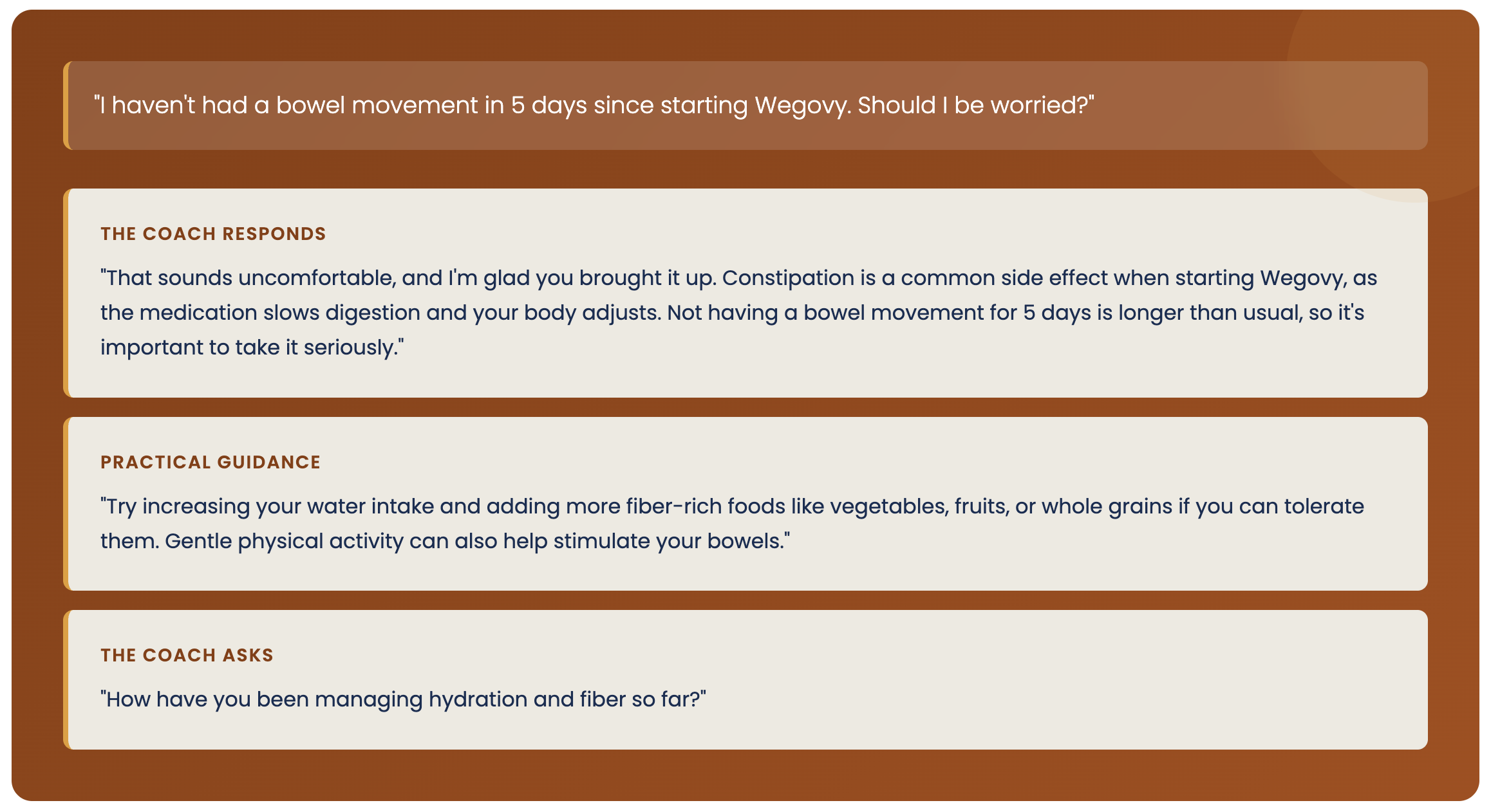
"I'm on Ozempic and I haven't pooped in five days. Is this normal?"
"I started Vyvanse and now I'm ravenous at night. Did I break my metabolism?"
"I just ate an entire sleeve of cookies and I feel awful. What do I do now?"
"My weight hasn't changed in three weeks even though I've done everything right. Should I increase my dose?"
"I genuinely enjoy sweets. Does that mean I have a problem?"
You won't Google these questions. Because then Google knows. And suddenly every ad, every suggested search, every piece of content you see online reminds you of the thing you're trying to figure out in private.
So you sit with the question. You worry about it. You make assumptions about what it means. You decide you're probably doing something wrong, and that anxiety shapes your next decision, and the spiral continues.
This is why we built our Digital Appetite Coach into The Shift Clinic. Not to replace physician care, that's something entirely different. But to answer the questions you've been sitting on for weeks. The ones you've typed into search bars and then deleted. The ones that feel too small to bother your doctor with but too important to ignore.
What the Coach actually does
The Digital Appetite Coach isn't a chatbot spouting generic encouragement. It's an intelligent messaging system powered by Nymble Health and customized with The Shift methodology, designed to help you build appetite literacy, the ability to read your hunger, wanting, and fullness signals as data rather than moral failures.
Someone messages: "Despite having a big breakfast and starting on Vyvanse, I'm currently feeling hunger. Do I lean into this and get something to eat?"
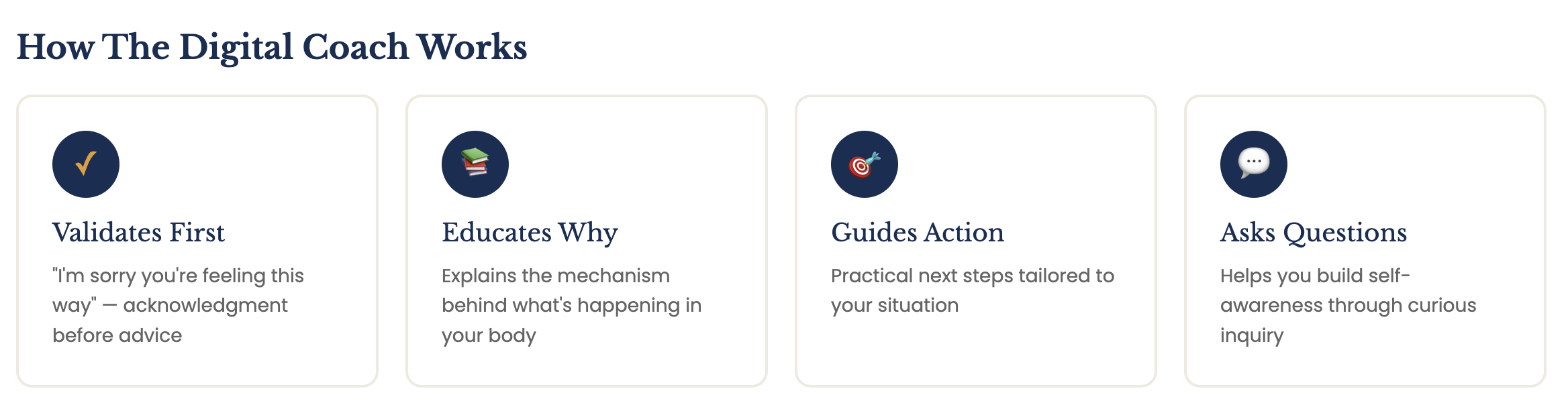
The Coach responds by validating the experience first. Hunger can still show up after a big breakfast, especially when starting medications that affect appetite in different ways. Then it provides education: since you're feeling hungry, it's okay to listen to those signals. Maybe try a small, balanced snack with protein and fiber to keep you satisfied until your next meal.
Then it asks clarifying questions: Have you noticed if your hunger tends to come at certain times or with specific activities? How long has it been since breakfast?
This isn't telling you what to do. It's teaching you how to think. How to interpret the signals your body sends. How to respond with curiosity instead of control.
Cravings as information
Most weight loss programs treat cravings as problems to eliminate. Willpower failures. Evidence that you're not trying hard enough.
The Shift treats cravings as data.
When someone messages the Coach asking whether enjoying sweets means they have a problem, the response reframes the entire question. It's completely okay to genuinely enjoy sweets during your weight management journey. Enjoying the foods you love helps make your approach feel more balanced and sustainable.
The key is finding ways to include sweets mindfully, so they satisfy you without overwhelming your hunger or overall health goals. The goal isn't to eliminate satisfying treats occasionally. It's to avoid feeling like you have to give them up completely.
Sometimes cravings can be linked to emotions or habits, so noticing when and where they happen can give you clarity on how to respond differently. Would you like some tips on how to track or manage your relationship with cravings as they come up?
This is appetite literacy in action. Not control. Comprehension.
The Coach helps you see that your craving for chocolate mousse at 4 PM might be telling you something useful. Maybe you didn't eat enough at lunch. Maybe you're stressed and your body wants comfort. Maybe you genuinely love the texture and temperature contrast of cold, creamy desserts and there's absolutely nothing wrong with that.
The difference is whether you respond with guilt or with information. Whether you spiral into "I shouldn't want this, what's wrong with me" or approach it with "interesting, let me figure out what this is about."
When medication changes everything
GLP-1 medications like Ozempic, Wegovy, Mounjaro, and Zepbound have transformed obesity medicine. They work. They suppress appetite effectively. For many people, they're life-changing.
They also create new questions that most clinics aren't equipped to answer in real-time.
Your appetite on medication doesn't behave the way it used to. You might feel hungry shortly after eating. You might have zero appetite for days and then suddenly be ravenous. You might experience nausea, constipation, or food aversions that make eating feel complicated.
These changes are often normal. But when you're experiencing them at 7 PM on a Wednesday, you don't know that. You just know something feels wrong, and you're not sure whether to push through or adjust something.
The Coach provides context for what's normal when starting or adjusting GLP-1 medications. It helps you understand that your appetite getting louder underneath the medication doesn't mean the drug stopped working, it means your body is adapting to being at a lower weight, and there are ways to manage that without automatically increasing your dose.
It explains that if you do a dose increase and feel really unwell, the commonly accepted protocol is to go back down for at least a month and then try again. You don't need to push through misery. You don't need to suffer to prove you're serious.
This kind of guidance doesn't replace your physician. But it provides support in the moments when you need to make a decision and your next appointment is weeks away.
Why privacy matters here
The Digital Appetite Coach operates within The Shift Clinic's contained system. Your questions stay between you and your care team. There are no algorithms tracking what you ask. No search history creating targeted ads. No performance required.
This matters because the questions people are most reluctant to ask, about bowel movements on Ozempic, night eating on stimulants, what to do after binge eating, are often the most clinically relevant. When asking requires bravery, people simply don't ask. They make assumptions instead, and those assumptions shape decisions in ways that undermine their care.
How this fits into care
The Coach works as part of an integrated clinical system, not as a standalone app.
In The Shift Clinic, members learn the MAP Framework through structured curriculum, how Metabolism, Appetite, and Perspective interact. They receive physician-led medical care that explains the reasoning behind treatment decisions. They track meals and receive weekly nutrition reports with clinical feedback that interprets patterns rather than just displaying data. They participate in a moderated community and attend live Strategy Sessions every eight weeks to recalibrate their approach.
The Coach connects these elements to daily life. It helps translate what you're learning in the curriculum to the decision you're facing right now. It reinforces the appetite literacy skills you're building. It provides context when something feels confusing between appointments.
This is responsive support, not reactive crisis management. The goal is building capacity to interpret your own signals, not creating dependence on external validation.
Integration, not fragmentation
Most weight loss care is fragmented. You might have a prescribing physician who doesn't provide behavioral support. A therapist who isn't trained in obesity medicine. A tracking app that has no connection to your medical care. A community that isn't moderated by professionals. Workshops that aren't connected to your actual treatment plan.
You end up coordinating everything yourself, translating between systems that don't speak the same language, trying to reconcile conflicting advice.
The Shift Clinic operates differently. Medical care, education, coaching, community, and strategy work function as one system under physician leadership. What you learn in curriculum shows up in coaching conversations. What gets discussed in community informs clinical decisions. What happens in Strategy Sessions shapes your medical approach for the next eight weeks.
The Coach is one component of that system. Not a replacement for clinical judgment or human connection, but intelligent support in the moments that actually determine whether knowledge becomes action.
The invitation
If you're tired of knowing what to do but struggling to do it, The Shift might be what you've been looking for.
Not another list of rules. Not more information you already have. But a system that teaches you how to think about your metabolic health, supports you in the moments when decisions actually happen, and integrates medical care with the behavioral skills that make sustainable change possible.
The Digital Appetite Coach is one part of that system. Available 24/7. Responsive to your questions. Designed to build appetite literacy rather than dependence.
Because the questions you're afraid to ask are usually the ones that matter most. And getting support for your health shouldn't require bravery.