the table stakes
Every December, the advice arrives on schedule. Eat before you go. Use a smaller plate. Position yourself away from the buffet.
These tips treat holiday eating like a logistics problem, as if the right strategy could outsmart the mashed potatoes.
But you've tried all that. You’ve had the best intentions and a solid plan.
And somewhere between your aunt's commentary and the third glass of wine, the plan dissolves.
Around holiday events, the food isn't the hardest part. The hardest part is everything happening around the food. The comments. The questions. The pressure to perform eating a certain way—for your family, for yourself, for some invisible audience tracking your plate.
Holiday meals can hijack your nervous system. Not just because you’re tired and the demands are high.
But also because it’s really easy to drop “Below Water” into reactive, automatic eating where you can't hear your body's signals clearly. And then you wonder why your plans don’t hold up to even a minor reality test.
I call the alternative Fearless Feasting. It's not about eating less or being "good." It's about staying “Above Water” so you can actually enjoy the meal.
why holiday meals scramble your signals
In my clinical practice, we track appetite across three dimensions: hunger-to-fullness, wanting-to-satisfaction, and eating-environment influence. That third dimension is where holiday meals get tricky.
Your eating environment includes everything external that shapes your eating: the physical space, the people present, the social dynamics, the time pressure, and the cultural expectations. When we rate the eating environment on a 0-10 scale, zero means chaotic and confusing (you can barely hear yourself think, let alone sense your appetite) while ten means complete clarity.
Most holiday meals land somewhere between two and four.
Holiday environments don't just challenge your appetite signals—they assault them from multiple directions. You're eating foods loaded with emotional memory, engineered to override satiety through combinations of salt, sugar, fat, and nostalgia. You're eating at unusual times, in unusual places, with disrupted routines. You're often with people who activate old patterns. And underneath it all: stress.
When your eating environment tanks, your nervous system responds predictably; you shift into what I call Red Mind—fight-or-flight activation. Heart rate increases. Breathing gets shallow. Digestion slows. So does metabolism. Your prefrontal cortex, the part responsible for conscious decision-making, goes partially offline. And food-seeking for pleasurable foods increases markedly. All of this happens involuntarily. You did not choose this totally unhelpful nervous system and hormonal response. Evolution did, and now it’s 2025. But your brain doesn’t know that either.
In Red Mind, you're reactive instead of responsive. You reach for food without deciding to. You eat past fullness without noticing. You're drawn toward rapidly available fuel—sweet, easy to digest, immediately pleasurable—because your body is prioritizing survival over long-term planning.
the real fear isn't food
In a recent group session, I asked patients what the holidays would look like if they weren't afraid of how much weight they might gain by the end of the season.
The conversation that followed revealed that the fear isn't really about food. It's about the conversations and judgment around your body.
One patient described dreading her European family's "eat, eat, eat" culture while navigating a changed appetite. Another mentioned a cousin who would definitely comment. Someone else talked about eating small portions publicly while sneaking leftovers in private because enjoying food openly felt too exposed to judgment. It’s sometimes easier to enjoy exciting foods in private.
If you are losing weight, people will comment on your body and what you eat.
If you are not losing weight, people will comment on your body and what you eat.
Whether you're on medication, off medication, losing, or maintaining, your body has always been treated as public property at holiday gatherings.
The difference now isn't that the comments will stop. The difference is having the skills to stay Above Water when they come.
fearless feasting is eating above water
Fearless Feasting is the practice of what we call Eating Above Water—bringing conscious intention to eating experiences even when the environment is working against you.
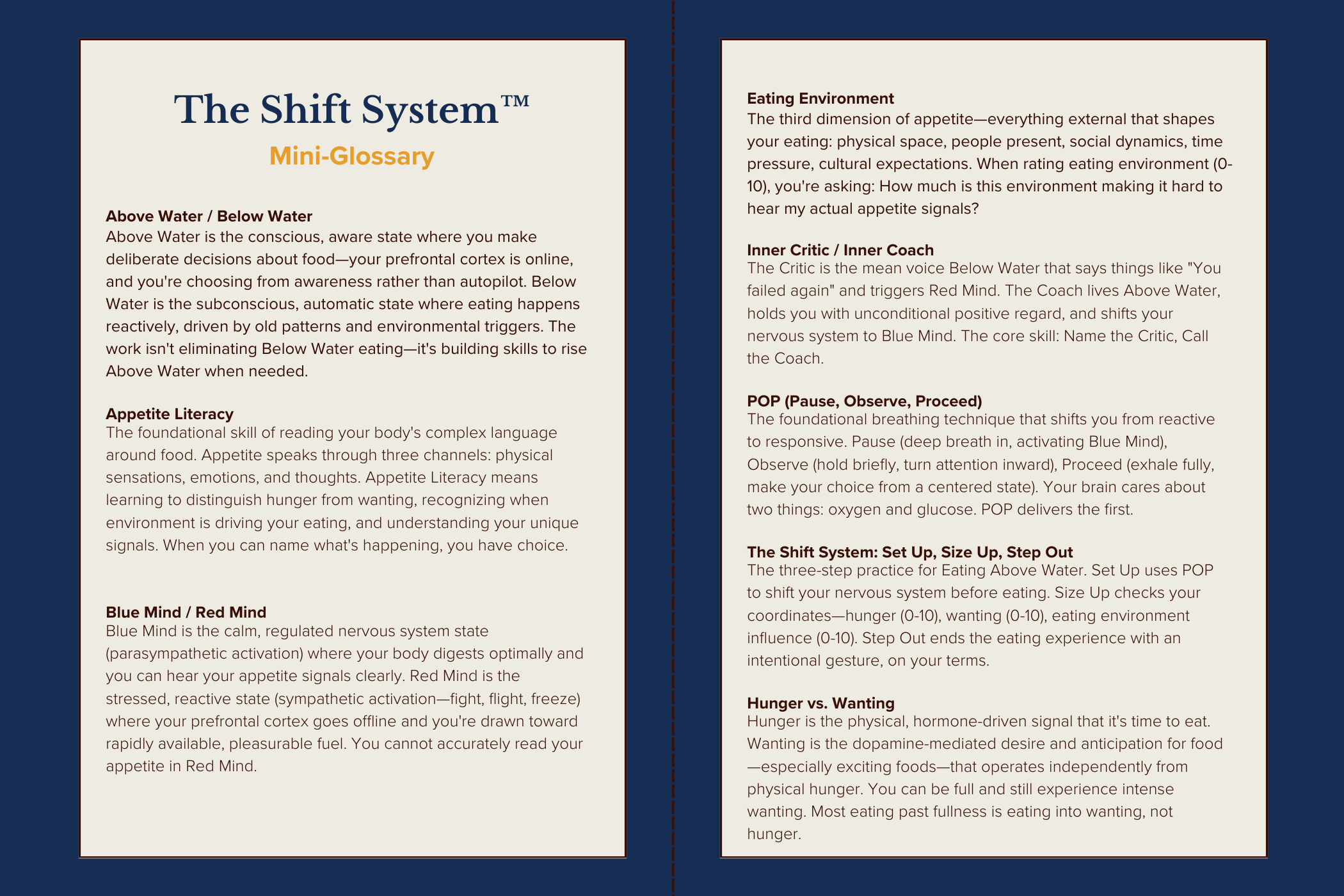
The system has three parts: Set Up, Size Up, and Step Out.
Set Up with POP. Before any holiday eating experience, you pause. Take one deep breath in through your nose, filling your lungs, letting your belly expand. Hold briefly. Exhale fully through your mouth. This single breath cycle—Pause, Observe, Proceed—activates your parasympathetic nervous system and moves you from Red Mind to Blue Mind. It sounds trivial. It's not. Your brain cares about two things: oxygen and glucose. When you flood your system with oxygen, you create the physiological conditions for clear thinking.
Size Up your appetite. After the breath, check your coordinates. Where are you on hunger to fullness (0-10)? Where are you on wanting to satisfaction (0-10)? How much is this environment influencing your signals (0-10)? You're not judging—you're reading. This is Appetite Literacy in action. When you can name what's happening, you have choice.
Step Out with intention. Create a simple gesture that marks the end of your eating experience—placing a napkin on your plate, taking a final sip of water, pushing your chair back slightly. Most people don't decide when to stop eating; they keep going until the food is gone or discomfort forces them to stop. The Step Out ritual lets you end on your terms.
the framework for fearless feasting
Based on real conversations with patients navigating this season, here's what Fearless Feasting looks like when you integrate Eating Above Water:
Trust over control. One patient described a transformation: she used to scour restaurant menus days in advance, planning every bite, calculating compensatory meals. This year? She's going to dinner Friday night and hasn't even looked at the menu. "I'll figure it out when I get there." That's fearless. A master sailor knows some storms just come—the weather forecast was fine, and then it wasn't. Trying to exert control over future eating scenarios makes you fragile. Trust in your ability to navigate is more masterful than elaborate planning.
Presence over preoccupation. Another patient said: "I haven't even thought about the food for the holidays. I know what I'm cooking. But I haven't flipped that switch of thinking, how am I gonna eat this? There's no food noise drilling in my head." No preoccupation. Just presence. This is what happens when you develop the skills to stay Above Water—the mental obsession quiets because you trust yourself to handle what comes.
Blue Mind over Red Mind. The holidays are Red Mind territory. That's why finding oases of calm matters so much. The bathroom is an oasis—two minutes, hands on the counter, POP breathing. Outside is an oasis—thirty seconds of cold air can interrupt a stress spiral. One ally at the table is an oasis—a calm presence who feels safe. These aren't escapes from the meal. They're resets that let you return to your body.
Boundaries over performance. You do not need to perform eating for anyone. Not "the right amount" to prove you're being good. Not "enough" to prove you haven't changed. If someone asks about your eating, you can say: "I'm eating when I'm hungry and stopping when I'm satisfied." That's the whole answer.
who deserves the truth
If you're taking obesity medication, you've probably already encountered the question of who to tell. Patients wrestle with this constantly around the holidays.
The people who deserve to hear the truth are the ones who have demonstrated a pattern of respect for you as a person. If someone has not done that, they haven't earned the invitation into your story.
One patient shared her plan for a family that weaponizes everything: "I'm just going to say I'm doing Weight Watchers." She'll carry a notebook. She'll say the points out loud. Is it technically true? No. Does it protect her peace in an environment where the actual truth would become ammunition? Yes.
You're not lying. You're protecting your nervous system from people who would use your vulnerability against you. Sometimes the kindest thing you can do for yourself is offer a simpler story.
For families capable of nuanced conversation, you can say: "I have a medical condition, and I'm getting medical help. It's actually quite complex." Whether they understand is not your responsibility.
the inner critic at the table
Holiday meals don't just trigger external critics. They amplify internal ones.
Your inner critic lives Below Water, in the murky, distorted part of your mind. It says things like: "You shouldn't be hungry already. You're so weak for wanting this. You failed again." These stories are old—survival mechanisms that were useful once but now just keep you stuck in Red Mind.
When you hear the critic, you don't need to argue with it. You just need to recognize it and call in the coach.
Your coach lives Above Water. The coach holds you with unconditional positive regard. The coach says: "Your brain needs oxygen and glucose—that's just biology. You can eat this if you want to. The meal is just information, not a test."
One patient described her son making comments about GLP-1s—repeating stigma he'd absorbed from social media. She admitted that two years ago, she thought the same way. That's the inner and outer critic meeting. The work isn't eliminating that voice—it's recognizing which voice is speaking and choosing which one to amplify.
Name the critic, call the coach. You can do it out loud if you need to: "That's my critic. My coach says something different."
showing up is fearless
Here's what I want to leave you with: fearlessness isn't about putting yourself front and center. It isn't about making big pronouncements or defending your choices at the dinner table.
Sometimes fearlessness is just showing up. Going to the party even though you're nervous. Eating at the table even though someone might comment. Being there, in your body, present to whatever happens.
One of my colleagues said it perfectly: "If you show up to the Christmas party and you don't talk to anyone but you're there—that counts. That's fearless."
You don't have to be perfect. You don't have to stay Above Water for every bite. When you notice you've dropped Below Water—even after the fact—that's awareness building. That's the skill.
the practice
One more time, here's your Fearless Feasting framework for the holidays:
Before you eat (and as often as you like during): POP. One breath. Drop into Blue Mind. Then Size Up—rate your hunger, wanting, and environment. Know your coordinates before the environment scrambles them.
During the meal: Return to your body. Size Up: evaluate hunger-to-fullness, wanting-to-satisfaction and the eating environment. Make decisions from Blue Mind as you enjoy the process of nourishing yourself.
When you're done: Step Out with intention. Choose your ritual. Put the meal behind you. No lingering guilt, no compensatory planning.
When someone comments: You have options. Boundaries ("I don't discuss my eating"), deflection ("my stomach's been a bit off"), or truth for those who've earned it ("I'm getting medical help for a medical condition").
When the critic gets loud: Name it. Call the coach. Don't argue—just recognize which voice is speaking.
That's Fearless Feasting. Not about the food. About staying present when the environment wants to knock you underwater.
Happy feasting!
If you want structured support in developing Appetite Literacy and the skills to navigate eating—holiday or otherwise—The Shift Clinic provides medical care, education, coaching, community, and strategy built around these frameworks.
Want to learn more about the practice behind this approach? Read about why a prescription is never enough.