The Photo Lied: Why Your Body Image Needs Motion
She hadn't been to a party in over a year.
Not because she didn't want to. Because the idea of being seen felt like too much. Too much effort. Too much exposure. Too much risk that the way she felt inside wouldn't match what other people saw.
Then things started to shift. Her health was improving. Her confidence was coming back in small, measurable ways. She was breathing easier, moving more, and for the first time in a long time, she actually wanted to go out. When she found a vintage 70s costume that fit, a fun short skirt she'd tucked away, she felt something she hadn't felt in a while. She looked in the mirror and thought, I look good.
She went to the Halloween party. She had a great time.
And then she saw a photo.
If you've ever experienced the gut-drop of seeing a picture of yourself that doesn't match the way you felt in the moment, you already know what happened next. The confidence crumbled. The good night rewrote itself. And the inner voice that had been quiet for weeks suddenly had plenty to say.
This is one of the most common and most devastating experiences my patients describe. And it's one we actively build skills to navigate at The Shift Clinic.

The ornament trap
What my patient experienced has a name. Researchers call it self-objectification, the habit of viewing yourself from the outside in, as though you're an object being evaluated rather than a person moving through the world. Dr. Lindsay Kite and Dr. Lexie Kite, twin sisters with PhDs in body image research from the University of Utah, wrote the book on this. Literally. In More Than a Body: Your Body Is an Instrument, Not an Ornament, they describe how women are conditioned to treat their bodies as ornaments, decorative, static objects that exist primarily to be looked at.
When you see your body as an ornament, your value becomes tied to how it appears in a single frozen frame. A photo. A mirror. A reflection in a shop window. And if that frame doesn't meet the standard, a standard shaped by decades of media exposure, diet culture messaging, and internalized weight stigma, the whole experience collapses.
My patient had just had one of the best nights she'd had in months. She had laughed, connected with people, felt alive. But one two-dimensional image was enough to override all of it.
That's the ornament trap. It reduces a full, rich, three-dimensional experience to a single visual data point. And that data point is almost always evaluated through a filter that was never designed to be kind.
Your body is doing things
Here's what the photo didn't capture.
It didn't show that she walked into a party she never would have attended six months ago. It didn't show that she chose a costume she actually liked instead of defaulting to the safest, most concealing option. It didn't show the reduction in shortness of breath that allowed her to stand and talk for hours. It didn't show the smile that came from genuine confidence rather than performance.
A photo can't hold any of that. A photo is a flat, still, two-dimensional representation of a moment. It captures light and shadow at a fraction of a second. It has no context, no movement, no story.
So I asked her to try something different. Instead of looking at the picture, I asked her to play the video.
Picture vs. video
This is the reframe that changed things for her, and it's one I now teach as a core resilience skill in The Shift System.
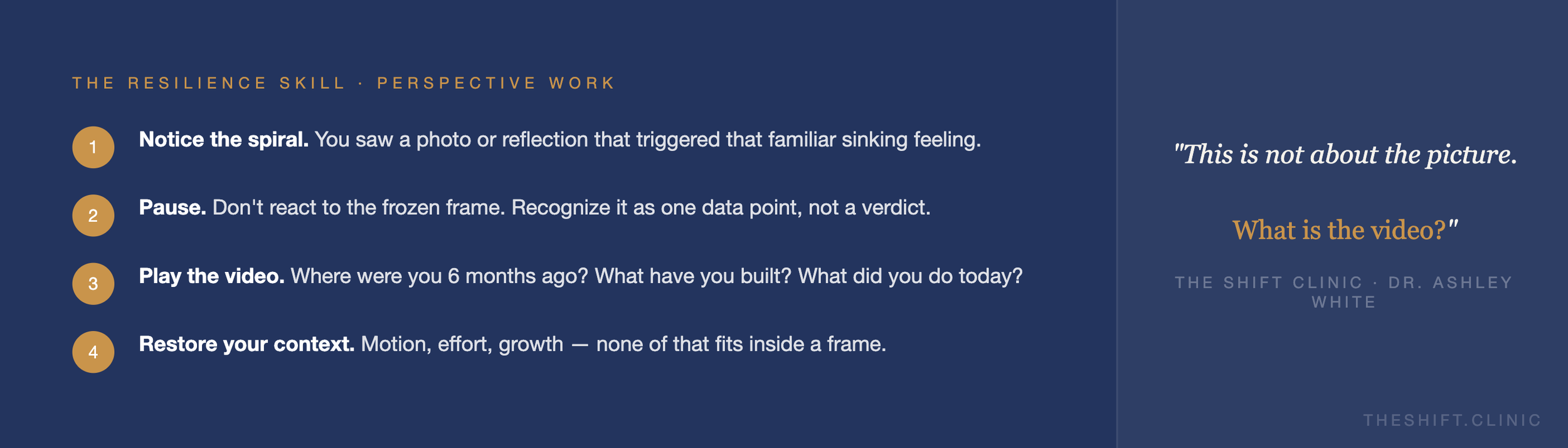
The picture is the ornament view. Static. One angle. One moment. Evaluated against impossible standards by the part of your brain that has been trained since childhood to judge female bodies. When the Inner Critic gets hold of a photo, it becomes a courtroom exhibit: evidence of everything you haven't fixed yet.
The video is the instrument view. It includes motion, context, change over time, and everything the picture can't hold. When you play the video, you see a woman who is getting healthier. Who showed up somewhere she wouldn't have gone before. Who wore something she actually wanted to wear. Who smiled because she meant it.
The video includes the before: the isolation, the avoidance, the breathlessness, the shrinking. And it includes the now: the rebuilding, the showing up, the slow return of a personality that had been going underground.
A picture shows you a body. A video shows you a life.
Self-objectification is expensive
This isn't just about feeling bad after seeing a photo. The research on self-objectification shows it carries real, measurable costs to women's health and functioning.
Objectification theory, originally proposed by psychologists Fredrickson and Roberts, describes how the habit of monitoring your own appearance from an outsider's perspective leads to increased body shame, appearance anxiety, and disrupted internal awareness. When you're constantly evaluating how you look, you lose access to how you feel. You stop noticing hunger, fullness, fatigue, and pleasure because so much of your mental bandwidth is allocated to surveillance.
For women navigating weight management, this is particularly destructive. The shame spiral triggered by a bad photo or an unflattering mirror moment doesn't just ruin your evening. It activates the stress response, pushing your nervous system into what we call Red Mind at The Shift Clinic, that reactive, fight-or-flight state where your prefrontal cortex goes offline and appetite regulation becomes nearly impossible. The very thing that makes you feel terrible about your body also makes it harder to care for your body well. That's not a coincidence. It's a cycle. And breaking it requires a specific skill.
Building the skill
When my patient came in after the Halloween party, she was deflated. The photo had undone what felt like weeks of progress. But here's the thing about progress: it wasn't actually undone. The health improvements were still there. The confidence she'd built was still real. The only thing that changed was her interpretation of a single image.
So we practiced the video.
I walked her through a guided visualization. Instead of the frozen frame, I asked her to see herself in motion. Walking into the party. Choosing the costume. Getting dressed with excitement instead of dread. Arriving and being greeted. Laughing. Staying late because she was having fun, not leaving early because she felt exposed.
The shift was immediate. Not because the visualization was magic, but because it restored context. The photo had stripped it all away, and the video put it back.
This became a permanent tool in her resilience toolkit. Now, when she sees a reflection or a photo that triggers that familiar sinking feeling, she doesn't spiral. She pauses. And she asks herself one question:
This is not about the picture. What is the video?
Why social media makes it worse
If you're thinking this sounds like it applies to more than party photos, you're right.
Social media is an endless stream of two-dimensional, curated, static images designed to be evaluated. Every scroll is an invitation to self-objectify, to look at another body as an ornament and then turn that same lens on yourself. Research confirms the link: studies consistently show that higher social media engagement is associated with increased self-objectification and body image disturbance in women.
The problem isn't that you're weak or susceptible. The problem is that the platform is designed to keep you in picture mode. You see a curated, filtered, posed, two-dimensional image of someone else's life and then evaluate your own three-dimensional, uncurated, unfiltered life against it. That comparison was never going to be fair. You're comparing their ornament to your instrument, and the instrument will always lose that contest because it was never designed to be still.
Your life is not a photo. It's a video. And the video includes the mess, the motion, the effort, the growth, and all the things that don't fit inside a frame.
This is perspective work
At The Shift Clinic, we organize care around the MAP Framework, Metabolism, Appetite, and Perspective. The "picture vs. video" reframe sits squarely in Perspective, which addresses how you see yourself, your body, your capacity, and how you navigate setbacks.
Perspective headwinds, the forces that make your navigation harder, include weight stigma, internalized diet culture, trauma, and self-objectification. These aren't minor inconveniences. They actively undermine every other piece of health work you're doing. You can optimize your nutrition, calibrate your medication, improve your sleep, and still find yourself derailed by a photo that triggers a shame spiral. Because your nervous system doesn't distinguish between a physical threat and an identity threat. Both push you into the same reactive state.
This is why The Shift System teaches resilience skills alongside metabolic and appetite work. You need the ability to catch yourself in the ornament trap, interrupt the spiral, and return to the instrument view. Not once. Repeatedly. Until it becomes automatic.
If you're curious about how your perspective patterns might be influencing your health, the Shift Strategy Quiz is a good starting point. It identifies your operating pattern and helps you understand where your specific headwinds are coming from.
The skill that stays
Here's what matters most about this patient's story. She didn't just feel better after our session. She built something she could use again.
The next time she caught an unflattering reflection, she didn't need me to walk her through it. She went to the video herself. She remembered what she'd been doing, how she'd been feeling, what was different about her life compared to six months ago. She restored her own context without needing anyone else to do it for her.
That's the whole point. Not a moment of comfort in a clinical appointment, but a skill that lives in your toolkit permanently. Something you can reach for at a party, in a dressing room, scrolling through your phone, or standing in front of a mirror on a hard day.
Your body is not a picture to be evaluated. It is a life in motion.
The question is never how you look in the frame. The question is what the video shows about where you've been, what you're building, and who you're becoming.
And when that critic in your head tries to reduce all of that to a single still image, you now have a response:
This is not about the picture. What is the video?