Oprah Stopped Her GLP-1. Her Body Didn't Care.
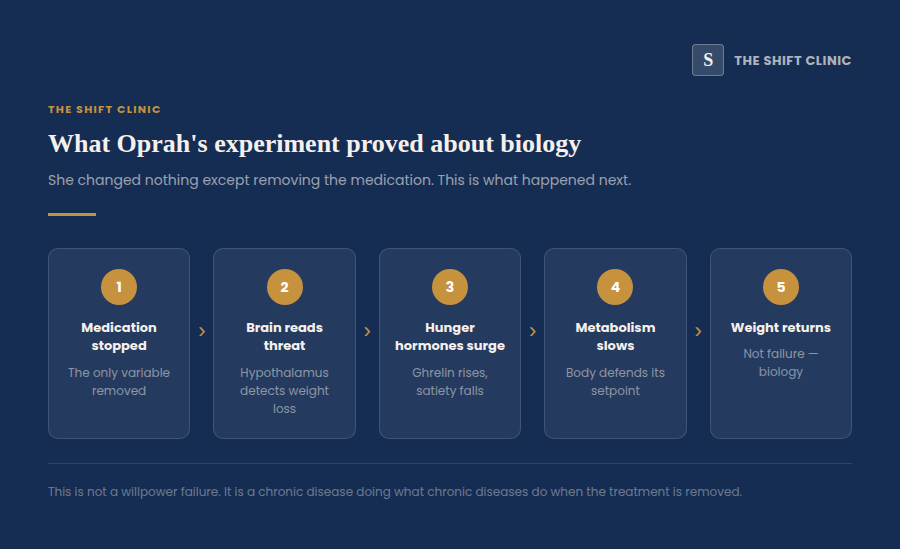
On her 70th birthday, Oprah Winfrey stopped her GLP-1 medication. She wanted to prove something. She kept her diet. She kept her exercise. She changed nothing except removing the prescription.
Twenty pounds came back.
She now calls lifelong weight loss medication "a lifetime thing" and compares it to her blood pressure pills. And that comparison, from a woman who built an empire on sheer force of will, is one of the most useful things anyone has said publicly about obesity in years.
The cleanest experiment
Oprah didn't fall off track. She stopped treatment; her appetite strengthened, and her body defended its setpoint by gaining weight.
Your hypothalamus doesn't care about your resume. It runs a weight-regulation system that predates language, career ambition, and the concept of discipline. When you lose weight, that system reads it as a threat. Ghrelin goes up. Leptin drops. Metabolic rate slows. Your brain turns up the volume on hunger and turns down the volume on fullness, and it will keep doing that for years after the weight is gone.
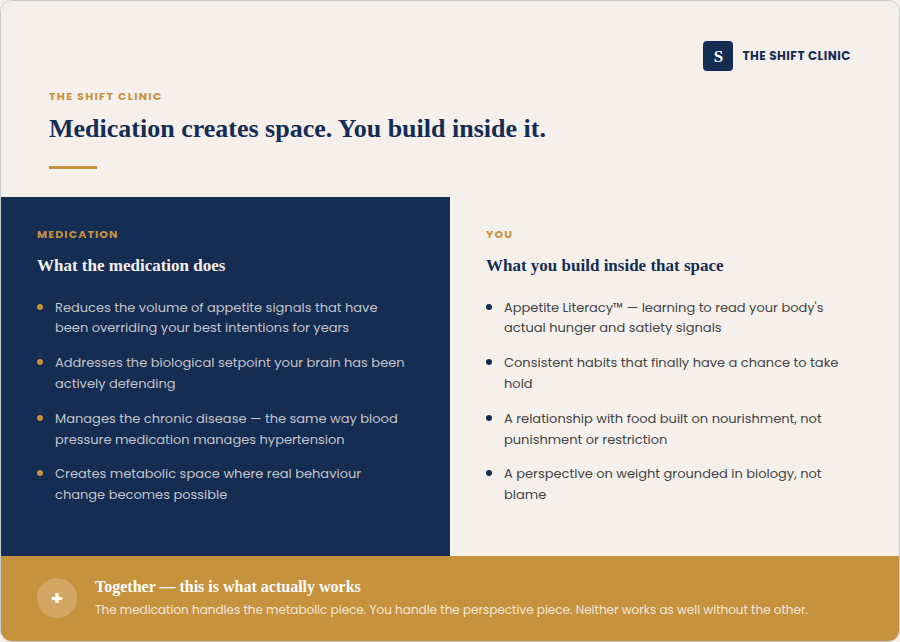
GLP-1 medications act directly on that system. They reduce the signal, not the person. Remove the medication, and the signal comes back. That's not relapse. That's physiology.
Nobody interrogates blood pressure pills
If you take medication for hypertension and your blood pressure stays normal, nobody asks whether you've "really tried" to fix it without the pill. Nobody suggests you should taper off to prove your commitment. Nobody calls it a shortcut.
But say you take medication for weight, and watch what happens. The skepticism comes from everywhere, including from inside your own head: I should be able to do this myself. If I were more disciplined, I wouldn't need this. The medication is doing the work, not me.
That voice isn't yours. It's the residue of a culture that still treats weight as a character issue. Research published through the National Institutes of Health shows that nearly 70% of people with obesity have been stigmatized by their own physicians. The medical system itself has reinforced the idea that this is your fault, even as every major medical body on the planet has classified obesity as a chronic disease.
Chronic diseases get managed. That's what the word means. You don't cure hypertension by being motivated about it. You don't resolve a dysregulated appetite center by wanting it more.
What "forever" actually sounds like
The question I hear most in clinic isn't does this work? Most patients already know it works. What they all eventually get to is:
Do I have to take this forever?
Short-term medication feels like a tool, and long-term medication feels like a verdict. If I need this permanently, something must be permanently wrong with me.
That's weight stigma, internalized so deeply it sounds like your own reasoning. You absorbed it from every doctor who told you to try harder, every diet that blamed your adherence, every magazine cover that framed thinness as an achievement of character.
Nobody with type 1 diabetes lies awake wondering if needing insulin makes them weak. The treatment fits the condition. The duration fits the biology. Same logic applies here. If your body's regulation system defends a higher weight, and a medication recalibrates that system, continuing the medication is continuing the treatment. Full stop.
What Oprah makes undeniable
Here's why this particular woman matters to this particular argument.
Oprah Winfrey survived childhood sexual abuse. She was pregnant at 14. She was functionally on her own by 12 and built one of the most influential media careers in history as a Black woman in 1970s Chicago television. She has personal chefs, physicians, trainers, and a schedule she controls entirely. She has spent decades publicly working on her health with every resource available to a human being.
If willpower were the variable, she would have solved this by 1985.
She didn't. And when she removed the one intervention that addressed her biology rather than her behaviour, the weight returned in months. Not because she failed. Because her hypothalamus did exactly what a hypothalamus does.
You don't have to prove anything to anyone
Oprah says she regrets the years she spent trying to prove she didn't need help. Decades of cycling. Decades of believing that needing treatment was a personal failure rather than a medical reality.
You don't have anything to prove.
If your treatment is working, and your appetite feels regulated, you're building habits that stick, your labs are moving, and your body is responding, then keep going. You don't owe anyone a trial period off it to prove you deserve it. You don't have to fail without it to justify staying on it.
Oprah figured this out at 70 and stopped apologizing. You don't need to wait that long. Willpower was never the part missing. The physiology was never the part that was addressed. Those are two different problems, and only one of them has ever responded to trying harder.
Curious what's actually driving your weight? Start with The Shift Clinic — physician-led care that treats your biology, not your motivation.